
 English
Menu
English
Menu




December 17, 2025
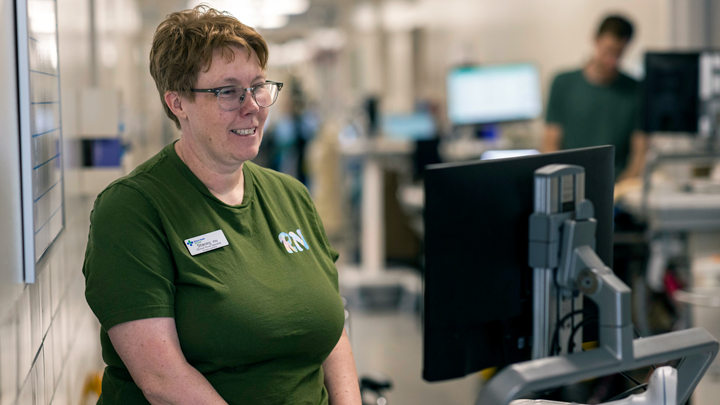
Clinical Nurse Specialist Stacey Middleton reviews trauma data at the Royal Alexandra Hospital, helping make nutrition screening part of routine patient care. Photo by Evan Isbister.
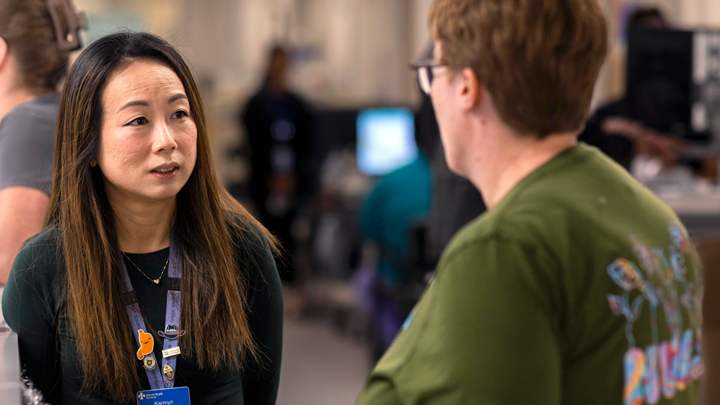
Registered Dietitian Karmyn Cheung, left, and Clinical Nurse Specialist Stacey Middleton work together to improve early nutrition screening for trauma and surgical patients at the Royal Alexandra Hospital. Photo by Evan Isbister.
Story by Jason Morton | Photos by Evan Isbister
EDMONTON — It started with a gap. Clinical Nurse Specialist Stacey Middleton was combing through trauma data at the Royal Alexandra Hospital (RAH) when she noticed something troubling — older trauma and surgical patients weren’t healing as well as expected. The numbers weren’t just numbers. They were people struggling to recover.
“Screening for risk of malnutrition wasn’t part of nursing practice in trauma and surgical units,” she says. “It wasn’t built into our process — and we were missing patients who needed help.”
Registered Dietitian Karmyn Cheung noticed the same issue. “We’ve always screened patients for malnutrition and provided interventions, but with so many patients to see each day, we couldn’t identify everyone. Some patients who could have benefited from timely nutrition support were being missed.”
This realization sparked a team effort to make nutrition a priority from the moment a patient is admitted.
Since April, trauma and surgical patients at RAH are screened for malnutrition risk using a simple two-question tool in Connect Care. If the screen shows risk, a referral to a dietitian is entered.
It’s a small change — but one with big impact.
“What’s powerful is how something this small can improve the care journey,” adds Middleton.
Screening rates, once non-existent in these units, now consistently top 80 per cent. That means more patients are identified early — especially seniors, cancer patients, and those facing food insecurity.
For trauma and surgical patients, early detection is critical.
“It’s like their body is running a marathon just to heal,” Cheung says. “Without enough calories or protein, wounds don’t mend well, infections can set in, and recovery slows.”
She compares proper nutrition to fuel for healing. “Without it, patients lose strength so quickly they can’t walk or care for themselves. We’re trying to prevent that. We’re giving them the best chance to get back to living their normal.”
The success of the initiative stems from collaboration among nurses, dietitians, educators, surgeons, and data analysts. “We’re using data to drive behaviour change,” Middleton says. “Once we started posting results, people saw the impact — and wanted to do better.”
With support from Dr. Lisa Martin, lead for Nutrition Services Research and Evaluation, the trauma and surgical team is now using Connect Care dashboards to track progress and keep momentum. The work also aligns with the Acute Care Bundle Improvement initiative, a provincial priority that uses data to improve patient care.
“This isn’t just a nursing project,” says Middleton. “It’s a shared effort. Nutrition is care. It’s healing. It’s dignity. And it starts with a question we should have been asking all along.”
For health advice 24/7 phone 811 a free health information service. You have options to speak with a variety of health professionals.
Alberta Health Services values your input. Your feedback will help us continuously improve the quality of Alberta's healthcare system.
Online payment is available for hospital stays, food handling permits, ambulance services, courses, parking citations, and parking permits.