
 English
Menu
English
Menu




January 13, 2026
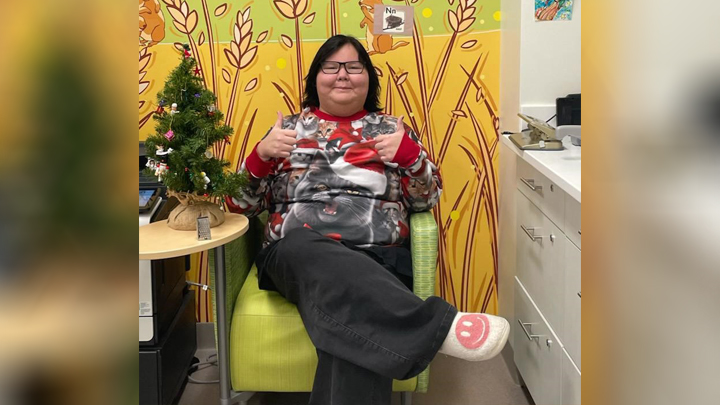
Barbara Severight is Canada’s first robot-assisted pediatric transplant recipient. The 16-year-old and her mother traveled from Cote First Nation in Saskatchewan for the groundbreaking procedure at the University of Alberta Hospital. Photo by Colleen Whitehawk.
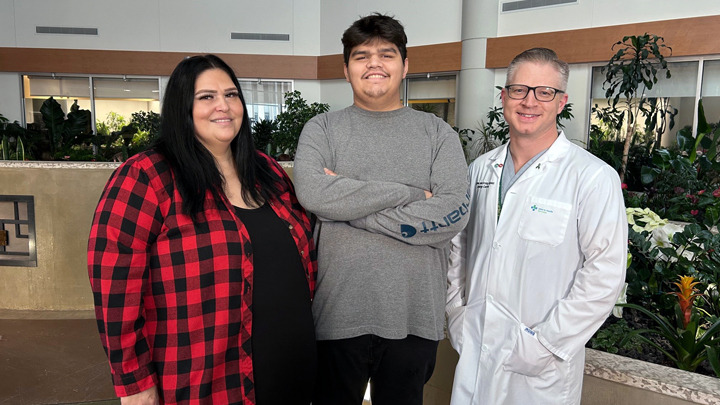
Dr. Max Levine, UAH Kidney Transplant Program Surgical Director, right, poses with Lisa Jackson and her son, Raiden Delaney. Since the summer of 2024, Levine’s team has performed 20 robot-assisted kidney transplants; Delaney is one of two pediatric recipients. Photo by Su-Ling Goh.
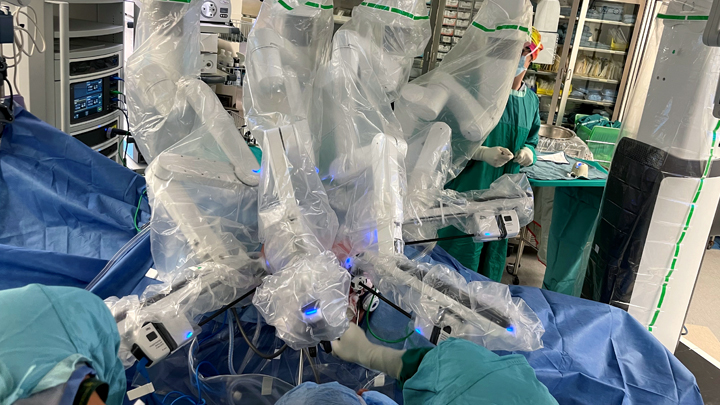
The da Vinci Xi Robotic Surgical System at the UAH is controlled via an arcade-game-like console. It allows surgeons to operate through much smaller incisions than with traditional open surgery. Photo by Dr. Max Levine.
Story & photo by Su-Ling Goh | Photos by Max Levine & Colleen Whitehawk | Video by Evan Isbister
EDMONTON — A University of Alberta Hospital surgeon and his team have once again made Canadian medical history. Roughly one year after performing Canada’s first robot-assisted kidney transplant in an adult recipient, Dr. Max Levine has changed the lives of two pediatric patients with the same procedure.
“I’m really happy for all of our recipients who got to experience the benefits of this (robot-assisted) procedure,” says Levine, the Surgical Director of the University of Alberta Hospital’s (UAH) Kidney Transplant Program. “It truly is a gamechanger for patients who are high-risk.”
“It’s pretty cool,” agrees 16-year-old Barbara Severight, who is Canada’s first robot-assisted pediatric transplant patient.
Since June of 2024, a total of 20 patients have received kidney transplants at the UAH via the robot-assisted technique. Levine uses the hospital’s da Vinci Xi Robotic Surgical System, with an arcade-game-like console to precisely control slender robotic arms. This allows for much smaller incisions (a few centimetres) compared to traditional open surgery (15-30 cm), which means less pain for patients, a quicker recovery, and most importantly, a lower risk of infection and other serious wound complications.
Severight was considered to have a high risk of wound complications. Her mother Colleen Whitehawk was so worried, she declined their first offer of a kidney transplant via open surgery in the summer. But when the opportunity for a robot-assisted transplant came in September of 2025, she didn’t hesitate.
“I was really scared for (my daughter) to suffer pain,” says Whitehawk. “(After the robot-assisted surgery) she had pain, but it wasn’t as bad.… She was laid up, but she wasn’t in severe pain.”
Levine’s team started the robotic program in 2024 with adult recipients and living kidney donors. Those cases were so successful, they have now progressed to more complex ones: two high-risk pediatric patients, each with deceased donors.
“There’s extra complexity with deceased donors,” adds Levine. “By doing these unscheduled (robot-assisted transplants), we’re asking our overnight and on-call nursing staff who don’t normally use the robot … to apply that in an unscheduled fashion.”
“To use this (robotic surgical system) on short notice, on an on-call basis for a specific procedure, is a novel concept in our hospital and our healthcare system. It’s pretty groundbreaking.”
Levine credits the UAH nursing, operating room, nephrology and leadership teams for being open to change and making this life-saving procedure possible for more patients. With open transplant surgery, about 10 per cent of patients need to return to hospital because of wound-related complications. Among the 20 robot-assisted transplant cases so far, there have been no complications — and, after the first few days, most patients required no more pain control than regular-strength Tylenol.
“I’ve seen how much of a strain (surgical site complications) have on patients and their families and the healthcare system in general, so it makes me feel happy to show that, as a program, we’re doing things to make these patients’ outcomes as good as possible.”
The second teenager to have a robot-assisted transplant, 16-year-old Raiden Delaney of Slave Lake, had IgA nephropathy, a disease which caused his kidneys to fail. He spent three years on peritoneal dialysis, connected to a blood-filtering machine every night. With his new kidney, he’s now enjoying his restored freedom, just in time for the holidays.
“I get to eat all the food I want. I get to drink all the fluids I want. I get to hang out with my family and my best friend,” says Delaney.
“That was exciting for us to know that he would be healing sooner, less time we would have to stay in hospital,” says Lisa Jackson, Delaney’s mother. “He could kind of return to being a kid.”
As for Barbara Severight — her kidneys started failing at age 11, and she spent four years on dialysis. She and her mother travelled from Cote First Nation in Kamsack, Saskatchewan for her transplant. The Grade 9 student is now back home and looking forward to painting landscapes again.
“I think it’s wonderful. It’s like a miracle surgery,” says Whitehawk. “I’m really thankful for (the robot-assisted technique) and for Dr. Levine and his team in Edmonton. They took really good care of (my daughter).”
To learn more about organ and tissue donation, visit GiveLifeAlberta.ca.
For health advice 24/7 phone 811 a free health information service. You have options to speak with a variety of health professionals.
Alberta Health Services values your input. Your feedback will help us continuously improve the quality of Alberta's healthcare system.
Online payment is available for hospital stays, food handling permits, ambulance services, courses, parking citations, and parking permits.