
 English
Menu
English
Menu




March 12, 2026
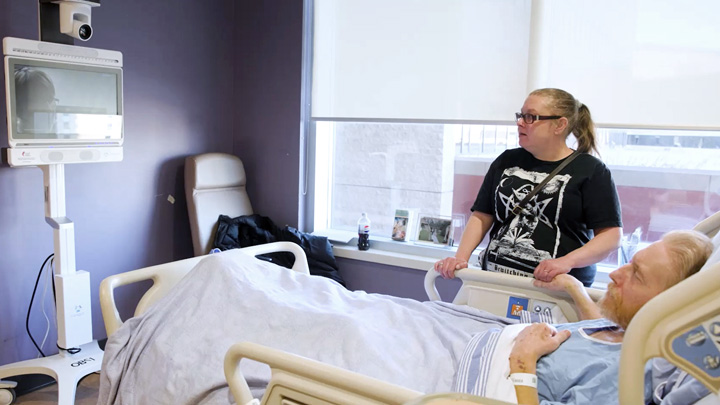
Paul and his daughter Katie Roberts chat with Virtual Observation attendant at the University of Alberta Hospital. Photo by Evan Isbister.
Story by Marni Kuhlmann | Photo & video by Evan Isbister
EDMONTON — A new initiative to enhance patient safety and support frontline staff has rolled out at the University of Alberta Hospital (UAH). The innovative Virtual Observation program allows trained attendants to observe patients remotely through a secure video feed for an extra layer of safety monitoring.
The Virtual Observation telemonitoring system is designed for patients who might be at higher risk of an adverse event — such as those who could fall, wander off, or act in unsafe ways — as well as patients on high-flow oxygen, who may accidentally dislodge a tube.
The technology sees a portable camera and monitor put in a patient’s room to sends video feed to the Virtual Observation team, located in another part of the hospital.
“Attendants watch patients on a screen, in real time, and can respond right away if something seems wrong,” says Dr. Alim Hirji, respirologist at University of Alberta Hospital and physician lead for the Virtual Observation Program.
“When they see a potentially preventable event about to occur — whether that’s a fall, removal of an oxygen tube, or aspiration — the attendant can quickly intervene before an adverse event occurs.
“The program started as a pilot project in 2021 and has shown meaningful benefits. We monitored over 18,000 patient hours and attendants detected more than 500 incidents when a patient inadvertently removed their oxygen tube. Quick intervention in these types of events led to a significant reduction in ICU transfers and deaths on the unit, and the number of patient falls on the unit significantly decreased as well.”
Katie Roberts’ dad Paul is monitored overnight as part of the Virtual Observation Program. She says the program brings peace of mind.
“Dad used to wander a lot. They had to have so many staff keeping an eye on him and the camera really eased that. It made it a lot better for the staff and for the family not to worry. It’s easier for me to sleep at night.”
The program doesn’t replace staff on a unit. Instead, the virtual attendant is an additional team member, who works with unit staff, ensuring patients receive timely support while reducing the need for constant in-person observation.
Before any monitoring begins, the care team will speak with the patients and families about the program to ensure consent. All video feeds are live only — nothing is recorded or stored — with privacy safeguards in place. For those in the program, it’s rewarding work.
“We’ve definitely had moments when we’ve been helpful to a patient, and it means a lot to know you’re there for somebody. Knowing that you changed someone’s life — or saved them from something — you really can’t describe it other than the feeling of joy and happiness,” says Kari Adhikari, virtual attendant and working leader for the Virtual Observation Program.
“It’s nice to be there for somebody, it’s nice to care for people and make sure they feel safe and their families feel they’re protected and feel loved.”
Dr. Hirji adds: “It’s really amazing to see the impact this program has. It’s a safe, transparent, and efficient system that helps both patients and care teams and has so much potential to help many more patients.”
The first phase of the Virtual Observation Program includes monitoring overnight, but 24-hour coverage could be added as the program evolves.
The team plans to expand the program to other units of the hospital and to other sites with plans for Calgary’s Peter Lougheed Centre and Leduc Community Hospital to roll out the program later this year.
The Virtual Observation Program is supported by the Alberta Innovates, the University Hospital Foundation and the Calgary Health Foundation.
For health advice 24/7 phone 811 a free health information service. You have options to speak with a variety of health professionals.
Alberta Health Services values your input. Your feedback will help us continuously improve the quality of Alberta's healthcare system.
Online payment is available for hospital stays, food handling permits, ambulance services, courses, parking citations, and parking permits.