
 English
Menu
English
Menu




May 4, 2026
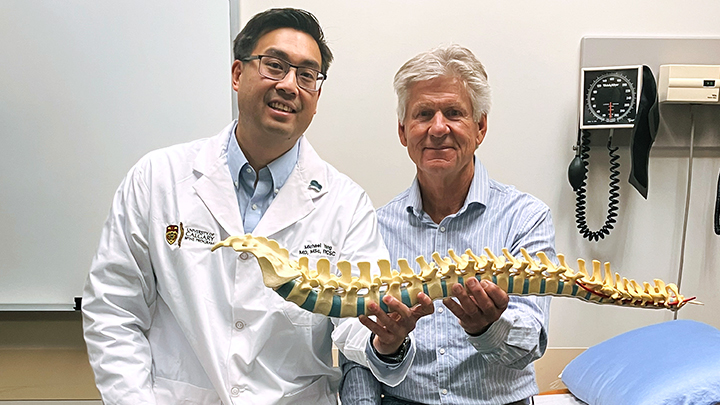
Dr. Michael Yang shares a smile with his patient Dale Bingham, who underwent transforaminal lumbar interbody fusion (TLIF). This procedure involves five small punctures — each about the diameter of a pencil in the patient’s lower back — through which the damaged disc is removed. As well, hardware to stabilize the spine is put in place, all while an endoscopic camera gives the surgical team a crystal-clear view of their task. Photo by Melanie Veriotes.
Story by Patrick Burles | Photo by Melanie Veriotes
CALGARY — On the morning of Jan. 15, Dale Bingham woke up to begin his daily task of mentally bracing himself to get out of bed. A misalignment between two vertebrae in his lower spine was compressing nerve roots going into his glutes and legs, turning once-simple acts like getting out of bed or walking into excruciating battles.
The next morning, after surgery, Bingham woke up in his own bed, but this time as he moved to start the day, he did so without the lightning bolts of pain he had grown to expect.
The 71-year-old Red Deer resident is among the first wave of patients to have been treated by Dr. Michael Yang, a neurosurgeon at Foothills Medical Centre, under the Calgary Endoscopic Spine Surgery Research and Advancement (CESSRA) program.
The program features a surgical technique that’s relatively new to Canada — the ultra-minimally invasive percutaneous endoscopic transforaminal lumbar interbody fusion (TLIF). This procedure involves five small punctures — each about the diameter of a pencil in the patient’s lower back — through which the damaged disc is removed. As well, hardware to stabilize the spine is put in place, all while an endoscopic camera gives the surgical team a crystal-clear view of their task.
“Oh my gawd, it worked,” Bingham recalls, his voice cracking with emotion, as he relives his first memory after surgery. “Dr. Yang wanted me walking not long after I woke up, and I could tell with those first steps that the pain was gone.
“The old man syndrome, as I call it when you get out of bed and can’t walk because of how much it hurts, had become all I could remember. I don’t have that anymore.”
Not only did he wake up to immense relief, but because of the drastically reduced scope of the procedure — seven-mm punctures as opposed to the traditional 10-cm incision — he was able to go home that night and sleep in his own bed. For a traditional spinal fusion, the average post-operative hospital stay is three days. Using this new method, the average stay is four to six hours.
“By not having to open the patient up, we’re not disrupting muscle, and there’s far less blood loss and less pain to start their recovery,” says Dr. Yang.
“Not only is this good for the patient, but by doing this as a day-surgery, we free up beds and staff to support other patients in need. This really aligns with Alberta Health Services’ goal of trying to do more surgery in ambulatory centres and building capacity within the healthcare system.”
The CESSRA program recently passed its first year in Calgary in January, treating more than 90 patients through its endoscopic approach. Dr. Yang says he hopes to see the annual number climb as his team continues to fine-tune their technique to reduce the time needed for each procedure, building on a long-term goal he set for himself early in his career.
“When I was a neurosurgery resident, my interest was around minimally invasive spine surgery,” says Dr. Yang. “My goal has always been to reduce the impact of surgical trauma on patients and speed up their recovery time, getting them back to their daily lives sooner.”
That took him to the University of Miami for his spine fellowship, pursuing cutting-edge techniques that he could bring home and be among the first in Canada to offer patients, including ‘awake surgery’ for high-risk patients.
Upon his return, Dr. Yang received funding support from the Calgary Health Foundation to help build the program.
“Most people are fearful of spine surgery, but our patients are getting the tip-of-the-spear of what is available for their care,” adds Dr. Yang. “They’re going home and recovering faster, with their incisions covered by a band-aid instead of a full dressing. It doesn’t have to be scary anymore.”
As for Bingham, he now walks between five to seven kilometres a day and attends physiotherapy as part of his recovery. He’s also thrilled to be weaning himself off the nerve-blocking medications that he previously relied on to get through his day-to-day life prior to surgery.
“On the drive home to Red Deer that first night, we stopped at a gas station next to a small field. I got out and just walked across it,” says Bingham, pausing for a deep breath and slow exhale, before continuing, “My life wasn’t impeded anymore — and it felt so good.”
For health advice 24/7 phone 811 a free health information service. You have options to speak with a variety of health professionals.
Alberta Health Services values your input. Your feedback will help us continuously improve the quality of Alberta's healthcare system.
Online payment is available for hospital stays, food handling permits, ambulance services, courses, parking citations, and parking permits.