
 English
Menu
English
Menu




June 25, 2026
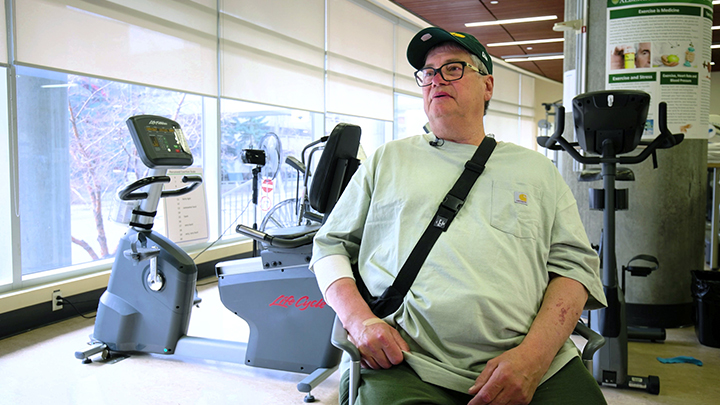
Norman Tanner takes a moment to chat after his cardiac rehabilitation session at the University of Alberta Hospital’s Mazankowski Alberta Heart Institute. Photo by Evan Isbister.
Story by Marni Kuhlmann | Photo & video by Evan Isbister
EDMONTON — Norman Tanner learned the hard way, it’s the simplest things you can miss the most.
“I wanted to be with my family. I wanted to be at home. I want to be able to go sit on the deck in the morning and have my breakfast or whatever,” says Tanner, cardiac patient at the University of Alberta Hospital’s Mazankowski Alberta Heart Institute.
“You know, the little things become pretty important when you can’t access them. Probably no one thinks about how much they like playing with their dog until they can't. Or just enjoying the sunshine.”
Tanner has been dealing with heart failure for more than 20 years. Nearly two years ago, his care team at the Maz implanted a ventricular assist device (VAD) into his chest, to do the work of his heart while he awaits a heart transplant.
For many patients awaiting transplant, a VAD allows them to leave the hospital and return to normal activities with a better quality of life at home. But some patients, like Tanner, have such severe heart failure that going home with a VAD isn’t an option. He spent months in the hospital, until January, when he became the first VAD patient in Canada to be released from hospital on an intravenous phosphodiesterase-3 (PDE3) inhibitor medication called Milrinone.
“The PDE3 inhibitor medication is used to treat heart failure by helping the heart muscle pump stronger and widening blood vessels. Norman was taking the medication in the hospital to strengthen his heart. Medically, he was doing well, but his quality of life was suffering,” says Dr. Holger Buchholz, director of the Pediatric and Adult Artificial Heart program at the Maz. “Our team decided why not try to develop a program that would allow this patient to safely go home on the medication.”
Since the VAD adds an extra layer of potential complication, developing the protocol took the cooperation of a large multi-disciplinary team including physicians, nurses, educators as well as experts from the pharmacy, home parenteral therapy, home care and social work teams.
“Patient safety is always our top priority,” says Dr. Buchholz. The PDE3 inhibitor is a perfect drug for home use, because the half-life time is very long. That means if something happens and the IV pump stops working, the patient would have enough time to come to the hospital — and it’s not an immediate life-threatening situation.”
Tanner proved a good candidate for home therapy, thanks to a supportive family who help him to carefully follow the protocol for IV medication. Once a week, he comes back to the hospital for VAD assessment, medication review, and cardiac rehabilitation at the Maz.
Tanner says he’s grateful for the care — allowing him more freedom to enjoy his life — while he waits for a heart transplant.
“It helps me stay positive and healthy until the heart comes. They have a pretty impressive team here. They don't just want to keep people alive — they want to get you back to doing your regular things. It’s just so wonderful that I don't have words for it.”
For health advice 24/7 phone 811 a free health information service. You have options to speak with a variety of health professionals.
Alberta Health Services values your input. Your feedback will help us continuously improve the quality of Alberta's healthcare system.
Online payment is available for hospital stays, food handling permits, ambulance services, courses, parking citations, and parking permits.