
 English
Menu
English
Menu




July 3, 2026
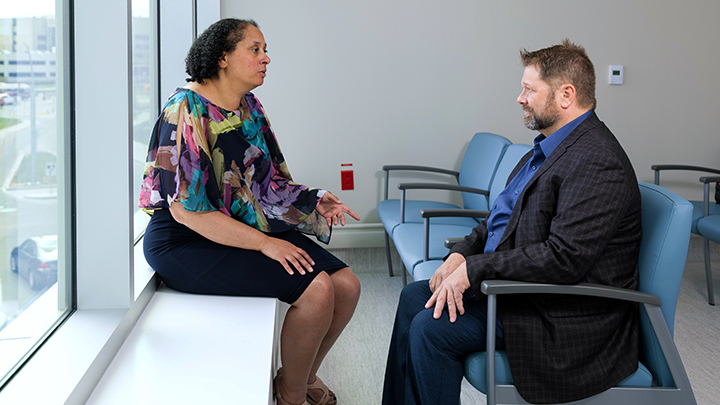
Dr. Mona Shafey meets with patient Kent B. at the Arthur J.E. Child Comprehensive Cancer Centre. Photo by Allie Miller.
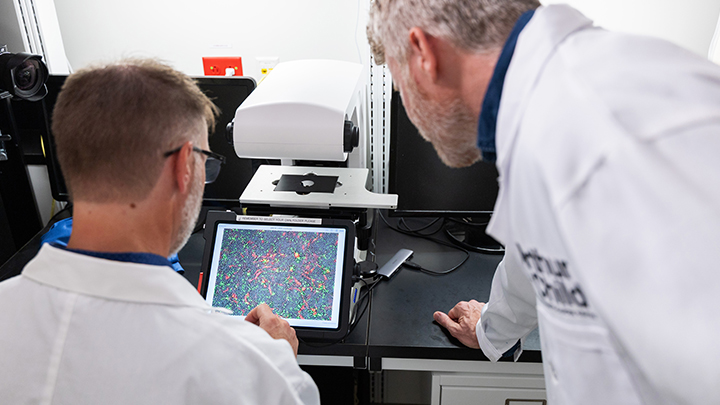
Microscope analysis can observe CAR T-cell productivity in recognizing and attacking cancer cells. Photo by Miranda Yee.
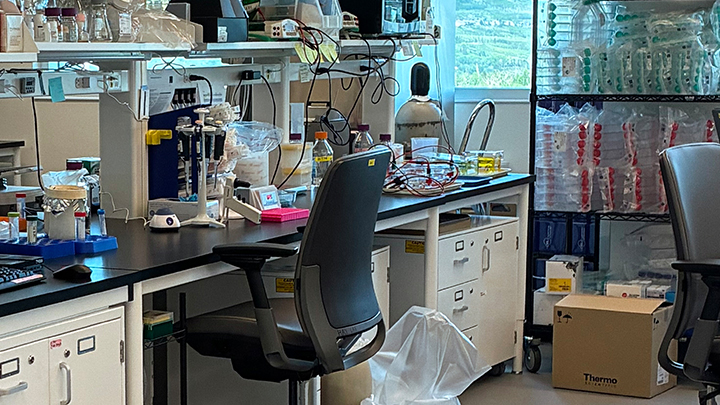
Inside a corner of Dr. Mahoney’s lab – steps from where patients receive care. Photo by Dean Parthenis.
Story & photo by Dean Parthenis | Photos by Allie Miller & Miranda Yee
CALGARY — A promising new immunotherapy is bringing together researchers, clinicians, patients and partners to move scientific discoveries from the laboratory directly to patient care. Developed by University of Calgary researchers, the discovery demonstrates the power of collaboration across Alberta's cancer system.
Published in Nature and Nature Cancer on July 1, companion studies led by researchers at the University of Calgary and McMaster University describe a new chimeric antigen receptor (CAR) T-cell therapy known as GCAR1. This experimental therapy — which trains a patient’s own immune system to recognize and attack cancer cells — is showing encouraging early results against certain difficult-to-treat solid tumours, such as sarcomas.
While the foundational scientific discovery was driven by academic researchers, translating this breakthrough into real-world patient care relies on the strength of Alberta's integrated health system.
Cancer Care Alberta plays a critical role in hosting early-phase clinical trials at both the Arthur Child J.E. Child Comprehensive Cancer Centre in Calgary, and the Cross Cancer Institute in Edmonton, providing the specialized infrastructure required to safely deliver novel, frontline therapies to its patients.
"Cancer Care Alberta's leadership in conducting early-phase clinical trials and caring for patients receiving novel therapies is helping accelerate promising research into treatments that can extend and improve lives,” says Dr. Mona Shafey, hematologist, cell therapy specialist, and co-principal investigator on the study.
“Partnerships between research leads, frontline clinicians, patients and Alberta’s cancer care system are absolutely essential to safely advancing the next generation of cancer care."
It’s here at the Arthur Child where this research and care merged to come to life. Dr. Shafey oversaw the treatment of Kent B., a Calgary patient with a rare soft-tissue cancer who had exhausted all standard treatment options.
Following his treatment, imaging showed that many of Kent's lung tumors had shrunk or completely disappeared, offering renewed hope and providing invaluable clinical insights to the pan-Canadian research team.
The lab where this research is being conducted and these novel therapies are being developed is only footsteps away from where patients are receiving their clinical care — in the same building.
The development and clinical delivery of the GCAR1 therapy highlights the strength of a fully synchronized network.
Dr. Douglas Mahoney, director of the Riddell Centre for Cancer Immunotherapy at the Cumming School of Medicine and principal investigator on the Nature Cancer study, led the pan-Canadian development of the novel therapy.
"This work reflects a close collaboration between the University of Calgary, Cancer Care Alberta, Alberta Precision Laboratories and other key partners around the country, bringing discovery science and clinical expertise together at every step,” says Mahoney.
This milestone was accelerated by vital community support, including funding from the Alberta Cancer Foundation, which remains a key partner in driving provincial cancer innovation.
“Our donors are powering progress, right here in Alberta – and Dr. Mahoney’s work is proof-positive of that impact,” says Wendy Beauchesne, CEO, Alberta Cancer Foundation.
“We are thrilled to see these immunotherapy breakthroughs coming from the Riddell Centre, and the promise they hold for thousands of Albertans impacted by cancer. We’re writing the future of cancer care in our very own province.”
This seamless interaction between laboratory discovery and clinical trial delivery reflects the core priorities of Alberta's Strategic Plan for Cancer to 2036. The province’s long-term strategy identifies advanced therapies, clinical trials, and integrated research partnerships as vital pillars for the future of medicine, accelerating the movement of promising innovations into patient care and expanding access to leading-edge treatments for Albertans.
For Dr. Shafey, the promise of GCAR 1 extends well beyond any single patient.
“Early phase clinical trials provide hope for the cancer patients who need them the most, allowing them to gain access to cutting-edge treatments that could help them and at the same time advancing the scientific knowledge needed to expand these therapies to other patients in the future.”
Learn more about this cancer-care breakthrough:
For health advice 24/7 phone 811 a free health information service. You have options to speak with a variety of health professionals.
Alberta Health Services values your input. Your feedback will help us continuously improve the quality of Alberta's healthcare system.
Online payment is available for hospital stays, food handling permits, ambulance services, courses, parking citations, and parking permits.