
 English
Menu
English
Menu




August 4, 2026
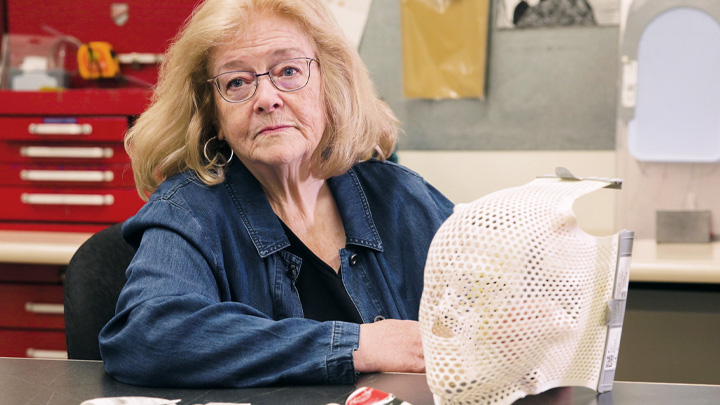
Volunteer artist Marilyn Kimura prepares to paint a face mask. She’s become an indispensable part of the pediatric care team at Cross Cancer Institute in Edmonton. Photo by Evan Isbister.
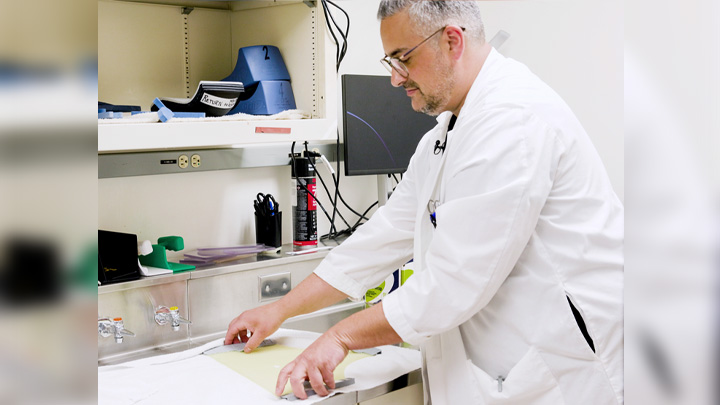
Long before a paintbrush touches plastic, Brandon Aboughoche is already at work, moulding the plastic for a child’s mask. A radiation therapist with more than 20 years at Cancer Care Alberta, he’s often the first person a child meets. Photo by Evan Isbister.
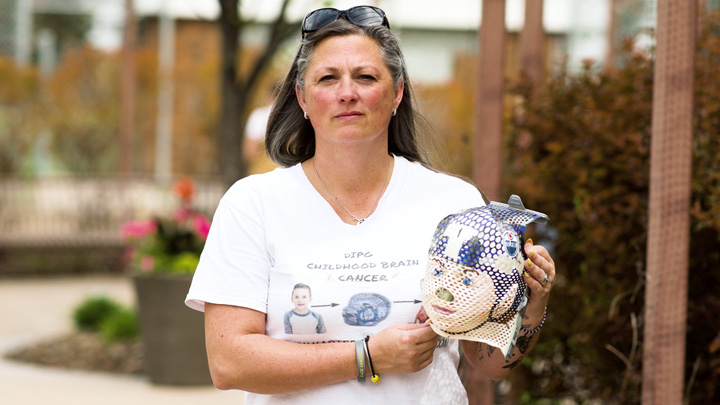
Nicole Fraser’s son, Karter, Bourgeault, was diagnosed with an aggressive form of pediatric brain cancer, and passed away in 2023 after bravely facing 41 rounds of radiation in his Edmonton Oilers mask. Today, she treasures it. “It's the only way that I can kiss my son now.” In his memory, she established Karter's Cancer Crusade Foundation to help other families. Photo by Evan Isbister.
Story by Dean Parthenis | Photos & video by Evan Isbister
EDMONTON — It takes a mould room technologist, a radiation therapist, a dedicated volunteer artist, and a parent's comforting support to turn a rigid face mask — one of the most intimidating pieces of equipment in pediatric cancer care — into something a child looks forward to wearing.
All children undergoing therapy to the head or neck must wear a custom-fitted, hard plastic mask to help guide the radiation. The shell is shaped precisely to their face. While manageable for an adult, for a five-year-old, it can feel like the scariest thing in the world.
Winston Poon, clinical supervisor, says roughly half of all cancer patients require radiation treatment. For kids, that reality carries a hefty emotional weight. The Cross Cancer Institute (CCI) in Edmonton, and the Arthur J.E. Child Comprehensive Cancer Centre (ACCCC) in Calgary, meet their fear head-on through their specialized pediatric mask program.
“They’re still children," adds Poon. "They still want to be kids."
For years, a small, deeply committed team at CCI has been transforming these rigid medical devices into something a child can truly call their own.
Nicole Fraser knows what it means to have that kind of team in your corner. Her son, Karter Bourgeault, was diagnosed with DIPG, an aggressive form of pediatric brain cancer, on July 26, 2022. Doctors initially told the family to go home and make memories. Instead, they chose to fight, supported by the CCI team.
Karter underwent 41 rounds of radiation between the ages of 5 and 6, completing every single session without sedation. He faced the machine armed with custom-painted Edmonton Oilers masks and his mother's voice singing to him through the treatment monitor.
"We would tell him he was Karter McDavid," Fraser recalls. "When you have a mask where you can be one of your heroes, it makes you feel stronger."
Karter passed away on July 23, 2023, but his masks remain with his family.
"It's the only way that I can kiss my son now," Fraser says softly. "I can still kiss his lips ... I can touch his face." In his memory, she established Karter's Cancer Crusade Foundation to help other families access clinical trials.
Her message to parents on the same road is fierce and simple: “You know your kid better than anybody. Advocate for your child. Follow your instincts. For us, it was a drooping smile and the slightest things.”
Long before a paintbrush touches plastic, Brandon Aboughoche is already at work, moulding the plastic for the mask. A radiation therapist with more than 20 years at Cancer Care Alberta, he’s often the first person a child meets. As a father of three, the weight of his work is never far from his mind. "When you have kids of your own, you definitely picture every child that comes through here as your own child," he says.
"Having staff who are truly empathetic, people who come and paint their shells, people who calm them during that very first experience … it makes it a lot easier for them."
He demystifies the intimidating environment by letting them hold the remote that raises the treatment table, letting them feel the warm plastic before it touches their face, and keeping the conversation light — focusing on video games, YouTube, and anything but the procedure ahead.
That painting falls to volunteer artist Marilyn Kimura. A retired Alberta government employee, she read a 2019 newspaper article about a hospital painter overseas and wondered if she could do the same as part of the 300-person strong Volunteer Resources team at CCI.
Fifty-two masks later, she’s become an indispensable part of the pediatric care team. Kimura believes volunteering has a positive impact.
“It does make a difference. It’s not something that, you know, you paint a picture and someone buys it years later and you never know what happens. This is a fairly immediate and very positive impact right off the bat.”
Working on a curved surface where up to half the material comprises mesh holes, Kimura uses non-metallic acrylics to paint superheroes, hockey helmets and butterflies. She even adds handcrafted attachments such as a felt police hat — or paper butterflies on a headband that bounce with every movement — bringing each character to life.
One memory still makes her smile — a three-year-old girl so taken with her cheetah mask that she refused to take it off. "That's probably the first time in history," Kimura laughs, "that anyone didn't want to take one of these things off.”
The team creates up to 10 specialized masks a year. But these masks, Poon is quick to note, are just one piece of a much larger philosophy: giving children back a sense of control when so much feels out of their hands.
Almost every family takes their child's mask home when treatment ends. For Fraser, hers is irreplaceable.
For the next child arriving at the Cross, often unsure of what to expect, it may be the exact thing that makes them just a little braver, and perhaps even a little excited, to return the next day.
"I have been very lucky in life," says Kimura. "So, if I can give back to people who might benefit from this — I see that not only as a privilege, but almost as a happy obligation."
Find out more about Karter's Cancer Crusade Foundation.
For health advice 24/7 phone 811 a free health information service. You have options to speak with a variety of health professionals.
Alberta Health Services values your input. Your feedback will help us continuously improve the quality of Alberta's healthcare system.
Online payment is available for hospital stays, food handling permits, ambulance services, courses, parking citations, and parking permits.