
 English
Menu
English
Menu




August 14, 2026
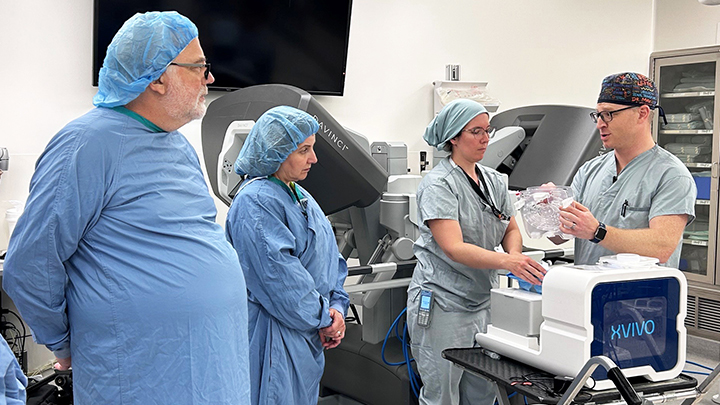
Kidney recipient David Cliplef, left, Adriana LaGrange (Minister of Hospital and Surgical Health Services), Lindsay Giese (Clinical Nurse Educator, UAH Adult OR) and Dr. Max Levine (Surgical Director, UAH Kidney Transplant Program) take a look at the XVIVO Kidney Assist — technology which allows donated kidneys to rest and rehabilitate before transplant. Photo by Su-Ling Goh.
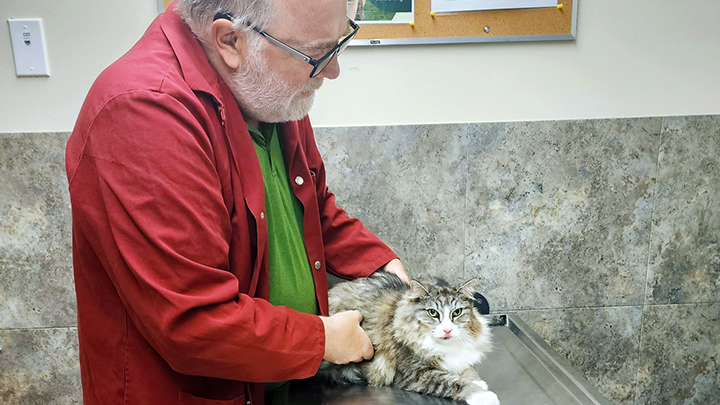
Onoway veterinarian David Cliplef was able to return to his little patients earlier than expected, thanks to Dr. Levine’s team using the XVIVO Kidney Assist and the da Vinci Xi Robotic Surgical System at UAH. Photo courtesy of David Cliplef.
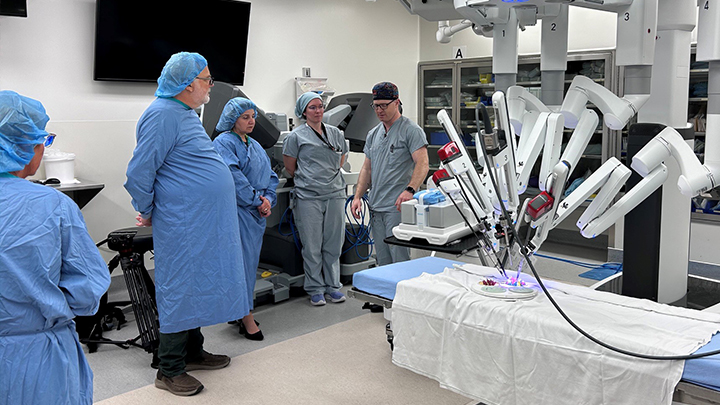
The da Vinci Xi Robotic Surgical System, in the foreground, allows for much smaller incisions and an easier recovery for patients like Cliplef. Photo by Su-Ling Goh.
Story by Su-Ling Goh | Photos by Su-Ling Goh & David Cliplef | Video by Evan Isbister & Kun Sirisopana
EDMONTON — Kidney transplant patients at the University of Alberta Hospital (UAH) are now accessing game-changing transplant technology: the XVIVO Kidney Assist. The UAH kidney transplant team, led by Dr. Max Levine, is the first in Canada to use this technology, which has improved outcomes for more than 40 patients so far.
“The donated kidney ‘wakes up’ faster, which helps (transplant) patients recover quicker and get out of hospital sooner,” says Dr. Levine, the surgical director of the UAH Kidney Transplant Program.
The XVIVO Kidney Assist keeps donated kidneys infused with oxygen and fluids outside the body for up to 24 hours, giving them time to rest and rehabilitate before transplant. This also gives transplant teams more flexibility to prepare for surgery.
“This pump gives us a lot of leeway and latitude in terms of making sure our patients get as good of a kidney as they can,” adds Levine. One of the challenges with kidneys from deceased donors is the stress an organ can experience during the dying process. This can cause delayed kidney function, with at least one in four kidney recipients requiring dialysis (blood-filtering treatments) after transplant surgery while they wait for their new kidney to begin working.
“That is stressful for patients, and it’s stressful for the healthcare team — we’re hoping the (donated) kidney works,” says Levine. “It also costs the (healthcare) system more because patients are going for more dialysis runs, and it keeps them in hospital longer.”
For David Cliplef, a recent kidney transplant recipient, the XVIVO helped deliver an outcome far better than expected.
The Onoway veterinarian was down to seven per cent kidney function when he was called for a transplant in May. He was told the deceased donor was older than average and agreed to accept the increased risk of delayed kidney function.
After spending 14 hours on the XVIVO, the kidney was transplanted into Cliplef and began working immediately.
Dr. Levine also used the minimally invasive da Vinci Xi Robotic Surgical System for Cliplef, allowing for smaller incisions than traditional surgery. This helped the 63-year-old experience less pain after surgery and recover faster, leading to his discharge after six days — three days sooner than average.
“My recovery went much better than expected, and I spent less time in hospital than I had been prepared for,” says Cliplef. “I had also been told to be prepared for up to three to four months off work and I’m back at work now, just two-and-a-half months later.”
“In my job as a veterinarian, I get to help patients, and I’m glad to be able to continue to do that.”
Now that Cliplef no longer needs dialysis every night, he hopes to be able to return to his on-call shifts soon.
“It feels pretty good to see your patients do so well,” says Dr. Levine. “That’s the goal — to get them off dialysis and living as full of a life as they can.”
The XVIVO company chose the UAH for the Canadian launch of the Kidney Assist based on Dr. Levine and his team’s track record of excellence. They also made Canadian history as the first to perform a robot-assisted kidney transplant in 2024, and the first to perform a robot-assisted pediatric kidney transplant in 2025.
Minister of Hospital and Surgical Health Services Adriana LaGrange recently met with Dr. Levine to see the transplant technologies and meet some of his colleagues.
“I just think it’s phenomenal that Alberta has this level of technology and expertise in our physicians, our surgeons and our nurses who are able to utilize this life-saving equipment,” says Minister LaGrange.
“We have a lot to celebrate here in Alberta, and we will continue to provide this cutting-edge technology to everyone who needs it and expand these types of programs.”
More than 500 people are waiting for life-saving transplants in Alberta.
For more information on organ and tissue donation, visit GiveLifeAlberta.ca.
For health advice 24/7 phone 811 a free health information service. You have options to speak with a variety of health professionals.
Alberta Health Services values your input. Your feedback will help us continuously improve the quality of Alberta's healthcare system.
Online payment is available for hospital stays, food handling permits, ambulance services, courses, parking citations, and parking permits.