
 English
Menu
English
Menu




October 9, 2026
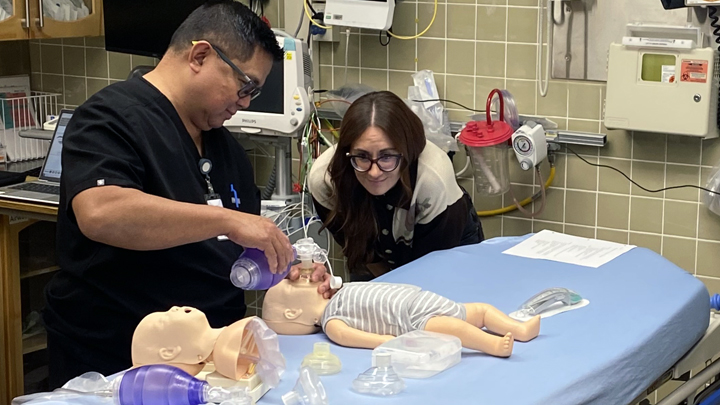
Laurie Teichroeb, Pediatric Intensive Care Unit (PICU) transport RN, and Dr. Kawmadi Abeytunge, PICU fellow, guide hands-on bag-mask ventilation practice and airway support training using an infant mannequin. Photo by Ryan LeMoal.
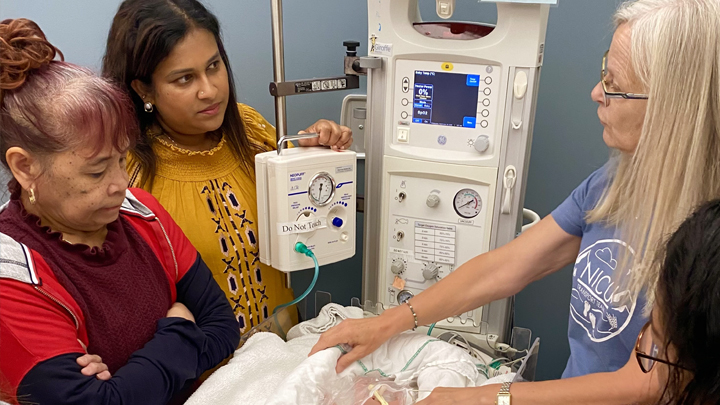
Heidi Haring, Neonatal Intensive Care Unit (NICU) Transport RN, provides hands-on education in premature infant care and thermoregulation during a neonatal training session. Photo by Alexandra Ward.
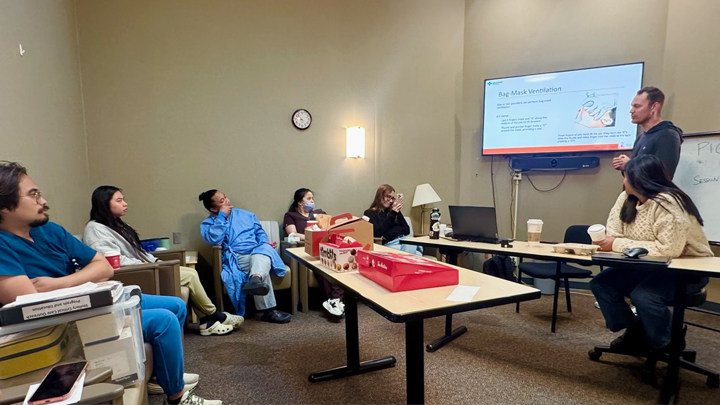
Participants take part in a PICU-led learning seminar on pediatric assessment, airway management, ventilation and intraosseous (IO) access, led by Kurt Zaborski, PICU Transport Rapid Response Team. Photo by Alexandra Ward.
Story by Allison Bowes | Photos by Rylan LeMoal & Alexandra Ward
Teams in High Level and Fort Vermilion have strengthened their skills to respond to serious medical emergencies for children and newborns thanks to the educational outreach of Stollery Children’s Hospital.
Recognizing that northern healthcare teams play a critical role in assessing and stabilizing critically ill children, at a time when every minute matters, Stollery specialists from Edmonton headed north to conduct hands-on pediatric and neonatal critical care education, to train local teams for a variety of complex medical situations.
Angie Mann, rural lead for High Level, Fort Vermilion, Rainbow Lake, Peace River, Grimshaw and Manning, notes that the north’s vast geography and travel distances add complexity when children or newborns require specialized care.
“Medical emergencies can happen anywhere, and children requiring urgent care are often far from Alberta’s children’s hospitals,” she says. “Our teams are ready and able to respond, and the specialized training provided helps ensure our young patients are assessed and stabilized close to home when seconds count.”
Supported by the Stollery Children’s Hospital Foundation, the Stollery Critical Care Outreach Program and Education (SCCOPE) partners with healthcare teams across Alberta to offer education, simulation, virtual health and clinical resources. The program helps boost local skills as it builds relationships between rural healthcare providers and pediatric and neonatal specialists.
For this type of outreach visit, the team includes physicians, transport nurses, respiratory therapists and simulation support from the Stollery’s pediatric and neonatal critical care programs.
Kurtis Zaborski, a registered respiratory therapist with the Stollery’s pediatric intensive care unit, has spent years travelling to rural communities to transport critically ill children — and has witnessed firsthand the value of outreach education.
“These SCCOPE trips are the missing piece. They allow us to connect with healthcare teams in rural communities in a way that isn't possible when we're on site to transport a critically ill child,” Zaborski says.
“We can share pediatric critical care knowledge, learn about the realities of providing care in smaller centres, and build relationships before an emergency happens. These connections help support collaboration when children need specialized care and ultimately strengthen care for patients and families across Alberta."
During their two-day visit, SCCOPE team specialists delivered pediatric critical care education at St. Theresa General Hospital in Fort Vermilion as well as pediatric and neonatal intensive care education at the Northwest Health Centre in High Level.
Local healthcare teams practised assessing patients, managing breathing and airway emergencies, providing respiratory support, administering medications, and stabilizing patients while arranging transfer to specialized care.
These simulated training sessions mimic real-world scenarios and give healthcare staff the opportunity to learn and practise skills using the equipment, resources and processes of their own hospital environment.
Through shared learning, local teams bring extensive knowledge of their patients, communities and practice environment, while the Stollery team brings pediatric and neonatal critical care and transport expertise. Together, these perspectives enhance care and improve the patient journey.
“By strengthening skills, confidence, and connections between local teams and our Stollery specialists,” says Klara Vigen, Stollery Critical Care outreach coordinator, “these outreach visits help support high-quality care for children and newborns across Alberta.”
For health advice 24/7 phone 811 a free health information service. You have options to speak with a variety of health professionals.
Alberta Health Services values your input. Your feedback will help us continuously improve the quality of Alberta's healthcare system.
Online payment is available for hospital stays, food handling permits, ambulance services, courses, parking citations, and parking permits.