
 English
Menu




October 19, 2026
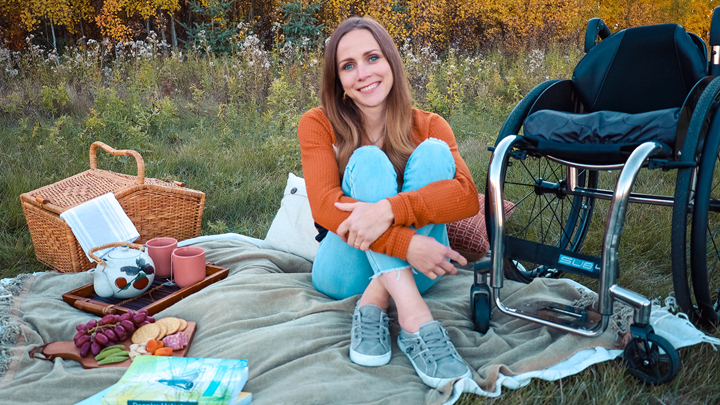
Brittney Neunzig is a volunteer at the Glenrose Rehabilitation Hospital in Edmonton. In her role as a patient and family advisor, she leans on her personal experience as a spinal cord injury patient to help improve the experiences of others. Supplied.
Story by Katie McLaughlin
EDMONTON — Brittney Neunzig is no stranger to Glenrose Rehabilitation Hospital. At the age of 13, she underwent rehabilitation here after a snowmobile accident left her paralyzed. Twenty-six years later, as a volunteer, she’s starting her third year as a patient and family advisor at the hospital.
“I haven’t been a patient for a long time, but I’ve stayed closely connected to the Glenrose as a peer mentor for patients with spinal cord injuries,” she says. “I see a lot of great things happening there for patients, but I also see some gaps that need to be addressed.”
As a patient and family advisor, Neunzig helps improve the quality, safety and experience of healthcare programs and services by sharing her own experience and perspective with the goal of improving service delivery for other Glenrose patients and their families.
“I have a lot of knowledge to share around what does and doesn’t work for patients, from my own experience and through my peer mentor work, and I wanted to be able to lend my voice in ways that help improve things for others,” she says.
At Alberta Health Services (AHS), these volunteer roles play an important part in patient engagement —something that staff across the Glenrose take seriously.
“Patient and family advisors bring diverse patient, family or caregiver perspectives to current and future healthcare programs and services at our hospital,” says Amanda Proctor, staff liaison for the Glenrose Patient and Family Advisory Council (PFAC).
“Advisors share their experiences and provide their insight and ideas on policies, procedures, redesigns, projects and research that impact healthcare delivery.”
As part of her involvement with the Glenrose PFAC, Neunzig has been asked to consult on different projects and initiatives, such as new patient webpages, apps and resources, as well as programs and policies. She brings her experience as a pediatric patient to the table, as well as what she hears and sees as a peer mentor.
“At one point we did a consultation about what information and resources are important to send home with spinal cord injury patients and how to best structure it,” she says. “Anytime I can influence something related to spinal cord injuries, I’m proud of it. I’ve also consulted on how user-friendly news apps, websites or surveys are.”
Neunzig adds that, as an advisor, she’s here to offer her advice and experience to decision-makers within the hospital, and sometimes more broadly within AHS.
Proctor adds: “Getting these voices to the table is essential in ensuring that patients and families are represented in the design of services they receive. Advisors are engaged in projects early and often to ensure that projects can progress with patient and family voices embedded in every step of the process. Without these volunteers, we wouldn’t have the depth of wisdom to draw from on the projects we undertake.”
Neunzig says: “Healthcare is a team sport, and I think that patients and families need to feel empowered and like their voices are being heard in all of the systems they have to be in.”
In addition to being an advisor, Neunzig also supports other spinal cord injury patients as a peer mentor, something she’s been doing for many years. She also teaches classes related to sexual health and returning to the community to newly injured patients on unit 3B, which is home to the Adult Spinal Cord Injury and General Neurology Inpatient program.
“I’m a parent, so I get asked if I can come in and chat with others that might relate to my own experience,” she says. “There might be a mom on the unit, and I’ll come in and talk to them about things like strategies for parenting from a wheelchair. I like doing that, too.”
While many view volunteering as a way of “giving back” to the community, Neunzig feels she gets even more back.
“Honestly, the best part of volunteering is what other people are giving back to me,” she says.
“Learning about other peoples’ lived experiences has really allowed me to have more compassion and empathy for people who have other disabilities and better understand their own experiences. I feel like I’m growing as a person because I get to do this.”
For health advice 24/7 phone 811 a free health information service. You have options to speak with a variety of health professionals.
Alberta Health Services values your input. Your feedback will help us continuously improve the quality of Alberta's healthcare system.
Online payment is available for hospital stays, food handling permits, ambulance services, courses, parking citations, and parking permits.