
 English
Menu
English
Menu




January 27, 2011
Story by Chris Simnett
When Mandy Carr fell off the edge of her deck while doing yardwork last summer, she experienced pain more intense than she had ever felt before.
“It was worse than childbirth,” the Drumheller resident recalls.
Carr, 50, completely tore her anterior cruciate ligament (ACL), badly strained her mediate cruciate ligament (MCL) and ripped the meniscus in her left knee.
Now, just more than six months later, Carr is active again, doing many of the things she likes to do – walking, hiking, cycling and golfing. She is hoping soon she will get back to curling and volleyball.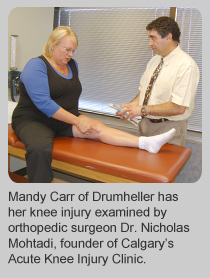
She credits the Acute Knee Injury Clinic at the University of Calgary with her speedy recovery. The clinic, funded by Alberta Health Services, gave her the treatment and knowledge she needed to speed her healing.
“This has been a great experience,” she says of coming to the clinic. “The staff here are very educated and, in turn, they educate you. That education about what my injury was and what I needed to do to get better has been absolutely crucial for my recovery.”
The Acute Knee Injury Clinic helps people who have torn ligaments or damaged cartilage and may not require surgery or an MRI scan. These patients are usually accepted into the clinic within days and can begin treatment soon thereafter.
“Between 50,000 and 100,000 Albertans sustain knee injuries every year and roughly 60 per cent of these individuals can fully recover with non-surgical treatment. The Acute Knee Injury Clinic is designed to identify those people and get them back to their normal routine much faster,” says clinic founder Dr. Nicholas Mohtadi, an orthopedic surgeon with the AHS Clinical Department of Surgery, Calgary Zone, and a clinical professor with the U of C.
This clinic has the ability to provide timely diagnosis and quality treatment for up to 200 patients per month.
Individuals who have sustained an acute knee injury within one month can be referred to the clinic by a family physician, who will provide ongoing follow-up and longer-term care in collaboration with the clinic. Alternatively, individuals can complete a self-referral questionnaire available at www.sportmed.ucalgary.ca/akic.
Once completed, the screening tool identifies appropriate individuals to be seen at the clinic. Patients with chronic conditions are directed to community supports and patients with more severe injuries to an emergency department.
Clinic patients are initially evaluated by a non-physician expert (NPE), a certified athletic therapist trained to evaluate and manage knee injuries by following evidence-based clinical guidelines. The NPE works directly with a sport medicine physician to provide primary care at a specialist level. Patients are provided a management and follow-up plan, discharged or referred to an orthopedic surgeon.
“The Acute Knee Injury Clinic can begin treating patients within a few days of their injury. This timely and direct access to expert care can prevent unnecessary MRI tests and inappropriate referrals for surgery, but most importantly results in improved outcomes for these patients,” says Mohtadi.
The Acute Knee Injury Clinic was established last year at the University of Calgary Sport Medicine Centre based on a research study involving more than 300 patients. AHS started funding the clinic earlier this month.
The innovative care model provided by the clinic is a one-year pilot project that will be evaluated by the Alberta Bone and Joint Health Institute using several measures, including:
“Alberta Health Services is committed to improving access and reducing wait lists for orthopedic services. The Acute Knee Injury Clinic helps us achieve that goal,” says Tracy Wasylak, AHS Vice-President and Co-Lead of the Bone and Joint Clinical Network.
“Not only does the clinic provide patients the right level of care in the right place, it reduces pressure on our emergency departments and frees up resources for patients with more serious orthopedic injuries or illnesses.”
Carr has been able to take what she learned at the clinic and pass it on to her physiotherapist in Drumheller. She’s worked very hard in rehab.
“If you want to get back to where you were before, you’ve got to do the work,” she says.
“Last week I was swimming in the Caribbean. I’m almost back to normal.”
For health advice 24/7 phone 811 a free health information service. You have options to speak with a variety of health professionals.
Alberta Health Services values your input. Your feedback will help us continuously improve the quality of Alberta's healthcare system.
Online payment is available for hospital stays, food handling permits, ambulance services, courses, parking citations, and parking permits.