
 English
Menu
English
Menu



March 11, 2011
Story by Gregory Kennedy
“A successful teacher should always leave students guessing a little bit.”
So goes the less-is-more philosophy of Dr. Scott North, a medical oncologist at Edmonton’s Cross Cancer Institute, who has just won a 3M Teaching Fellowship Award, Canada’s top award for university professors.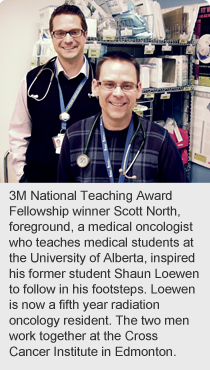
North’s national honour — one of only 10 handed out annually by 3M in partnership with The Society for Teaching and Learning in Higher Education — salutes his creative methods and unstinting enthusiasm as an associate professor for The Faculty of Medicine & Dentistry at the University of Alberta, where he introduces second-year medical students to the field of cancer care.
“Sometimes a medical teacher only has an hour with a student,” says North. “Some teachers feel they have to teach them everything there is to know about the topic in that hour-long interaction. All that ends up happening is that the students feel overwhelmed and frustrated, and walk away feeling like they’re never going to want to look at that topic again.
“What I try to tell my students up front is that it’s not my intention to make them a cancer specialist. It’s my intention to get them to think about the cancer patient and make them comfortable about working with a cancer patient. And then give them the necessary information so they can be competent. We’re planting the seeds and giving them the tools to be lifelong learners.”
Fellowship-selection criteria states award winners embody the highest ideals of teaching excellence and scholarship with a commitment to enhance the educational experience of every learner.
“That, plus the fact that his students are obviously crazy about him,” says Ronald Marken, 3M fellowship program co-ordinator in Saskatoon.
“Scott was instrumental in revolutionizing the way that medical students learn to interact with patients as people. He has had a profound effect in changing the way medicine is taught.”
For instance, North brought actors into the classroom to portray patients walking into a doctor’s office or being in the emergency room.
“The student has to interact with that patient to ascertain what their problems are, or do a physical examination to practise their technique … so they can get into the thought process of what it’s going to actually be like to be a real physician,” says North.
Former student Shaun Loewen says North gives difficult concepts new meaning and makes them easy to understand.
“He took us on tours of the Cross Cancer Institute, giving us hospital exposure quickly — something that we usually don’t get much of in first or second year medical school,” says Loewen, who has followed in North’s footsteps to become a fifth-year radiation oncology resident, and now colleague, to his mentor at the Cross. “Back then, I wasn’t really sure what I wanted to do. Scott’s teaching was my first exposure to oncology, which really planted the seed.”
North, who first came to the Cross as a resident in 1997 and joined the staff in 2000, will head to a Saskatoon conference in June, where he’ll officially receive his 3M award. Later this year, he’ll attend a Banff retreat with this year’s nine other fellows, to share in their teaching and learning experiences.
For health advice 24/7 phone 811 a free health information service. You have options to speak with a variety of health professionals.
Alberta Health Services values your input. Your feedback will help us continuously improve the quality of Alberta's healthcare system.
Online payment is available for hospital stays, food handling permits, ambulance services, courses, parking citations, and parking permits.