
 English
Menu
English
Menu




January 30, 2012
Story by Colin Zak, Photo by Paul Rotzinger
When Paige Nickason went to have her brain tumour removed in March 2008, she knew she was making surgical history.
In a medical first, doctors at Foothills Medical Centre removed Nickason’s tumour navigating a two-armed robot, called neuroArm, from a remote workstation in an adjacent room.
“With my condition, I had gone through surgery after surgery. But I was actually looking forward to the procedure,” recalls the 25-year-old, who has Neurofibromitosis Type II, a disease that causes recurring tumours in her head and spinal canal. 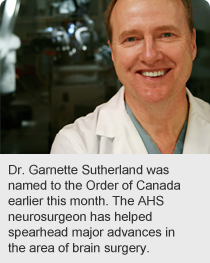
“It gave me a lot of piece of mind, knowing it was less invasive and they could make more precise cuts.”
Dr. Garnette Sutherland, the Alberta Health Services neurosurgeon who helped develop and design neuroArm, has now been named a member of the Order of Canada for his contributions to neurosurgery. He will be honoured in a ceremony with Governor General David Lloyd Johnston in Ottawa in the spring.
“It’s an acknowledgement that we’ve done some great work – not just me, but all the people who have worked on these projects to improve patient care and outcomes,” Sutherland says. “I’m glad the technologies we have developed are now being used around the world.”
Sutherland developed neuroArm in 2004 along with MacDonald, Dettwiler and Associates Ltd., the group responsible for Canadarm and Canadarm2. NeuroArm is the world’s first surgical robot that can perform microsurgery and image-guided biopsies.
During surgery, Sutherland and his medical team control neuroArm from a workstation, guiding its movements via images on a screen. Because it can move in smaller increments than the human hand, neuroArm enhances surgeon control, which is crucial when performing delicate surgery inside the brain.
Since 2008, his team has used neuroArm in 30 surgical cases.
NeuroArm is made possible by intraoperative MRI, a technology also developed by Sutherland and collaborators at the National Research Council Canada. Intraoperative MRI allows surgeons to bring an MRI scanner into the operating room on demand and take pictures of a patient’s brain during surgery.
“Surgeons can use the images to guide them. It’s very helpful during complex surgeries,” Sutherland says. “This way, surgeona knows they have achieved their surgical goals before leaving the operating room.”
Sutherland’s intraoperative MRI technology is now being used by neurosurgeons, endovascular surgeons and oncologists in 40 sites around the world, including University of Alberta Hospital.
“We’re hopeful the use of neuroArm will spread in a similar way,” Sutherland says. “Other surgical specialties are also seeing how these technologies might help them.”
Shawna Syverson, Vice President of Foothills Medical Centre, says Sutherland’s leading-edge work has continued to make Alberta a world leader in surgical care.
“The technologies developed by Dr. Sutherland play a key role in contributing to the excellent patient care and innovative research that happens every day at Foothills,” Syverson says. “We are very proud Dr. Sutherland has been recognized nationally for his achievements.”
Adds Nickason: “It means a lot to me that there are people like Dr. Sutherland developing tools that help patients like me.”
For health advice 24/7 phone 811 a free health information service. You have options to speak with a variety of health professionals.
Alberta Health Services values your input. Your feedback will help us continuously improve the quality of Alberta's healthcare system.
Online payment is available for hospital stays, food handling permits, ambulance services, courses, parking citations, and parking permits.