
 English
Menu
English
Menu




May 19, 2026
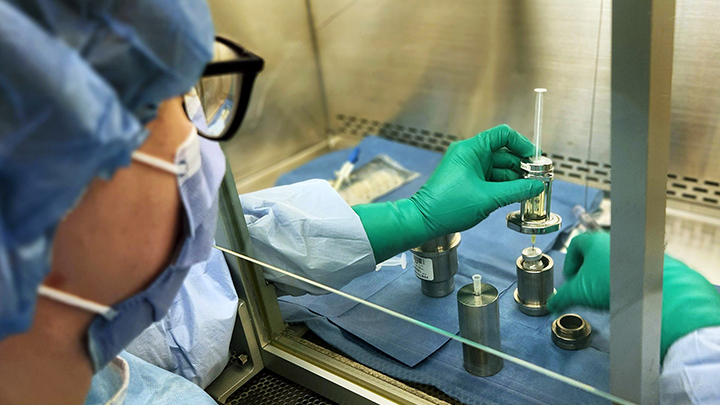
Here a radiopharmacy specialist prepares Technetium Tc-99m sodium pertechnetate — a radiopharmaceutical used in nuclear medicine for imaging organs such as the thyroid, salivary glands, brain and urinary bladder. Tracer Hub produces this important medicine daily. Radiopharmaceuticals improve patient outcomes by helping doctors find diseases earlier and more accurately, and by providing targeted treatments. Supplied.
Story by Ashley Graydon
EDMONTON — When a patient enters a hospital for care, many moving pieces happen behind-the-scenes to ensure the most effective and timely diagnosis and treatment. This is where radiopharmaceuticals come in — making possible important scans and treatments — for patients with conditions such as cancer, heart disease and brain disorders.
Radiopharmaceuticals are medicines with a very small amount of radioactivity that are used safely and routinely in medical care. Depending on the type of radiation produced, they fall under one of these categories: PET (Positron Emission Tomography) or SPECT (Single-photon Emission Computed Tomography).Each type requires a special camera for imaging.
“Radiopharmaceuticals improve patient outcomes by helping doctors find diseases earlier and more accurately, and by providing targeted treatments,” says Mariusz Bereznicki, radiopharmacy supervisor at the Edmonton Radiopharmaceutical Centre and part of the Tracer Hub team.
“This means patients can get the right diagnosis sooner and receive treatments that focus directly on the problem area, often with fewer side effects.”
Tracer Hub is a provincial program within Alberta Health Services (AHS) Diagnostic Imaging that operates at both Edmonton Radiopharmaceuticals Centre (ERC) and Calgary Radiopharmaceuticals Centre (CRC). Tracer Hub, previously known as Radiopharmaceutical Services of Alberta, helps tens of thousands of patients a year by making and supplying these medications to the healthcare system.
These hospital medications are used in two ways:
In simple terms, Tracer Hub provides radiopharmaceuticals to help doctors identify and treat illnesses.
So, what does a typical day look like in Tracer Hub? It involves a mix of preparation, manufacturing, quality checks and, of course, lots of teamwork.
Production staff begin their day at 1 a.m.to ensure safe and timely delivery of radiopharmaceuticals to hospitals and diagnostic imaging sites across Alberta. The process begins with the production or preparation of radioactive material in carefully controlled quantities to create the radiopharmaceuticals. Each batch is rigorously tested — for safety, accuracy and effectiveness — to make sure it’s ready to administer to patients.
The team coordinates daily with hospitals and community clinics so doctors, nurses, and imaging staff get the medication in a timely manner. (Radiopharmaceuticals have short half-lives ranging from minutes to a few days, specifically chosen for rapid diagnostic imaging or targeted therapy, while minimizing radiation exposure.)
Blake Lazurko, cyclotron engineer at the Edmonton location, is responsible for making sure everything is in good working order to avoid delays.
A cyclotron is a powerful machine that speeds up tiny, charged particles using electric and magnetic fields. These particles, when directed at a target, create radioactive materials — also known as radioisotopes — that are used in making radiopharmaceuticals.
“My day-to-day work is largely preventative in nature,” he says. “To keep the equipment operating reliably in an extremely harsh environment, many components must be regularly inspected, replaced, rebuilt, and maintained. When failures occur, which they inevitably do, often in the middle of the night, we have to troubleshoot quickly and carry out repairs safely.
“Everything we produce is time-sensitive and only usable for that day. Any period of lost production, whether an hour or a day, means patients will lose access to their diagnostic procedures.”
While some hospitals have long-standing agreements for daily radiopharmaceuticals, others send in prescriptions the day before they’re needed through an electronic system. As approved by the Canadian Nuclear Safety Commission (CNSC) and Health Canada, all new batches are put in military-grade ammunition boxes (a shielded and padded container) with paperwork and then sealed for shipment. Once they arrive at their destination, staff sign off on the sealed product for use. It’s a well-oiled machine.
Few people realize that radiopharmaceuticals, unlike regular pharmaceuticals, can’t be stockpiled in batches to be distributed as needed.
“Radiopharmaceuticals are the epitome of just-in-time manufacturing,” adds Lazurko. “Because of the half-life of the typical PET radioisotope we work with — when it takes three to five hours to make a radiopharmaceutical start to finish, including the potential hours to ship — we’re constantly producing what’s being used that day.”
Bereznicki notes that many people mistakenly assume radiopharmaceuticals are hazardous simply because they contain radioactive material.
“The truth is that they are used in very small, controlled amounts and are generally safe,” he says. “With strict safety protocols and regulations, staff and patients have nothing to be concerned about.”
Timing, safety and quality are critical to the production and delivery of high-quality radiopharmaceuticals. Tracer Hub follows stringent radiation safety regulations and good manufacturing practices established by the CNSC and Health Canada.
In Calgary, the focus is slightly different.
Debby Sigouin, a radiopharmacy specialist at the CRC, explains that they distribute radiopharmaceuticals to all hospitals in the Calgary area, as well as to cardiac clinics.
“Another key focus for us is non-radioactive products, such as cold kits, unlike our counterparts in Edmonton,” she adds.
CRC manufactures these cold kits and conducts the required quality and safety testing prior to shipping them across Canada. Over the past decade, access to certain cold kits has proven challenging due to Canada’s small market size, which means limited interest from large pharmaceutical companies.
Tracer Hub stepped in to address this gap.
Despite a long and complex journey, Tracer HUB, based in Calgary, now supplies cold kits to more than 152 hospitals nationwide, ensuring equitable access for patients across Canada.
The new CRC, scheduled to open in 2027 at Foothills Medical Centre, will further support this work and enable growth within Alberta’s healthcare system. It will be Calgary’s first facility with a cyclotron — and Alberta’s third overall.
Sigouin waxes with enthusiasm about the new facility. “The new Centre will be the last missing piece of the puzzle to create a fully robust ecosystem. Calgary will support the central and southern parts of the province, while Edmonton focuses on the north.”
She adds that having more staff will create opportunities to introduce new radiopharmaceuticals and significantly reduce decay time by eliminating the need to transport radiopharmaceuticals daily from Edmonton to Calgary.
“This will also allow Edmonton to expand its support to other northern centres, while Calgary serves the south,” she says.
Lazurko adds that although the team is expanding with this new centre, they’ve been supporting the healthcare system for two decades.
“Without the reliable operation of our cyclotrons for the past 20-plus years, there would be no imaging radiopharmaceuticals to use with the PET/CT cameras that help detect and ultimately lead to treatment for patients.”
Learn more about Tracer HUB.
For health advice 24/7 phone 811 a free health information service. You have options to speak with a variety of health professionals.
Alberta Health Services values your input. Your feedback will help us continuously improve the quality of Alberta's healthcare system.
Online payment is available for hospital stays, food handling permits, ambulance services, courses, parking citations, and parking permits.